
For more than twenty years, businesses learned how to compete on the Internet around one basic idea: Google.
If someone needed an attorney, a veterinarian, a contractor, an accountant or almost any other service, they opened a search engine, typed a few words and started looking through the results.
Businesses adapted.
Websites were built around keywords. Companies invested in SEO. Marketing agencies fought for the first page of Google. Entire industries were created around one goal: appearing as high as possible when someone searched for what you sell.
And for a long time, that made perfect sense.
But the way people search for information is beginning to change.
Not because Google disappeared. It didn't.
Something else happened.
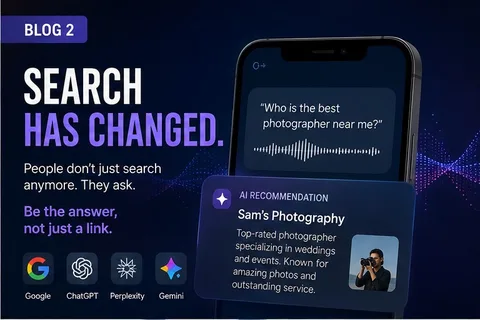
People discovered they could simply ask.
Instead of typing “best veterinarian Houston,” someone can now ask, “What is the best animal hospital near me for an older dog that needs ongoing care?”
Instead of searching “business attorney near me,” they may ask, “Who is a good attorney in Houston for a small business dealing with a contract dispute?”
Instead of opening ten different websites to compare options, they can describe exactly what they need and ask Artificial Intelligence to help them decide.
And that is a very different kind of search.
For years, search engines gave us a list.
Now, increasingly, people expect an answer.
That distinction may sound small, but for businesses it is enormous.
When someone searches on a traditional search engine, your company may appear among ten, twenty or a hundred results. The person can scroll, compare websites, read reviews and decide where to click.
When someone asks an AI assistant for a recommendation, the experience can be very different.
The person may receive a short explanation and only a handful of options.
Sometimes even fewer.
Which means a question that almost no business owner was asking a few years ago is quickly becoming important:
Does Artificial Intelligence understand your business well enough to mention it?
Most companies have spent years thinking about how humans see their websites.
Is the logo attractive?
Do the colors look professional?
Is the phone number easy to find?
Does the site look good on a mobile phone?
Those things still matter.
But now there is another audience reading your website.
Machines.
Search engines, AI systems and answer engines are trying to understand what your business does, where you operate, what services you provide, what questions you can answer and whether your information appears reliable enough to use.
That changes the purpose of a website.
A website can no longer be designed only to look good when a person opens it.
It also has to clearly communicate what the business is about to the systems that organize, interpret and increasingly recommend information.
This is where terms such as SEO, GEO and AEO have started becoming part of the conversation.
They sound technical, but the concepts behind them are actually quite simple.
SEO, or Search Engine Optimization, is the discipline businesses have used for years to help traditional search engines understand and rank their content.
GEO, or Generative Engine Optimization, focuses on helping generative AI systems better understand a company, its expertise and its information.
AEO, or Answer Engine Optimization, focuses on structuring information so that when someone asks a question, your content has a better chance of contributing to the answer.
Google’s own guidance on AI features confirms there is no separate approval process for AI Overviews: a page simply needs to be indexed and eligible to appear in regular search results, and Google’s systems then work to surface a wider, more diverse set of helpful links.
The terminology is new.
The business objective is not.
You want to be found.
What has changed is where people are looking and how they expect to receive the information.
Think about how different the customer journey can become.
A few years ago, someone looking for a service might search Google, open five tabs, visit several websites, read multiple pages and eventually decide whom to call.
Today, that same person can open an AI assistant and say:
“I need a company near me that does this, has experience with that, can work within this budget and is available soon. What do you recommend?”
The technology can help narrow the choices before the customer ever visits a website.
That means the battle for visibility may begin earlier than many businesses realize.
Your potential customer may already be forming an opinion about your company before they ever see your homepage.
And if the systems helping them search cannot clearly understand who you are, what you do and why your business is relevant, you may never even enter the conversation.
That is the part many companies have not considered yet.
A website can look modern, load quickly and have beautiful photography, while still doing a poor job of explaining the business to modern search technologies.
For years, companies redesigned websites when they looked outdated.
Now there is another reason to rethink them.
The Internet itself is changing.
We have seen this before.
At one point, a business could survive without a website.
Then having a website became important.
Later, having a website was not enough. It had to work on mobile devices.
Then businesses needed to think seriously about Google.
Social media changed customer discovery again.
Every time the way people use technology changes, businesses eventually have to adapt the way they present themselves.
Artificial Intelligence is simply creating the next version of that change.
And we are still at the beginning.
The question is no longer only:
“When someone searches Google, can they find us?”
A second question is becoming increasingly important:
“When someone asks Artificial Intelligence for help, does it understand enough about us to consider our business relevant?”
That does not mean abandoning traditional SEO.
It does not mean that Google no longer matters.
And it certainly does not mean stuffing a website with references to Artificial Intelligence.
It means recognizing that search is becoming broader.
Your digital presence increasingly needs to work for traditional search engines, AI-powered search experiences, voice assistants and systems designed to give direct answers.
In other words, for years the goal was to become one of the results.
Now businesses also need to think about how they can become part of the answer.
And that can require looking at a website very differently.
Is your expertise clear?
Are your services explained in language people actually use?
Does your website answer the questions customers are really asking?
Is your business information consistent?
Can technology understand your location, specialties, services and areas of expertise?
Does your content demonstrate enough knowledge and credibility to be useful?
These may become increasingly important questions in a world where your next customer may not discover your company by browsing a list of links.
They may discover it because an intelligent system recommended you.
The businesses that understand this shift early have an opportunity.
Not because anyone can guarantee that an AI system will recommend a particular company. No one can honestly promise that.
But businesses can make their digital presence clearer, better structured, more useful and easier for both people and technology to understand.
And that is becoming part of what modern visibility means.
If you want to understand whether your website is prepared for this new way people are finding businesses, talk to Sam Berner.
The conversation is not only about redesigning a website or adding a few keywords.
It is about understanding how search itself is changing and making sure your business is evolving with it.
Because your next customer may not type your service into a search box.
They may simply ask:
“Who do you recommend?”
And increasingly, the answer may be coming from Artificial Intelligence.
Talk to Sarah