
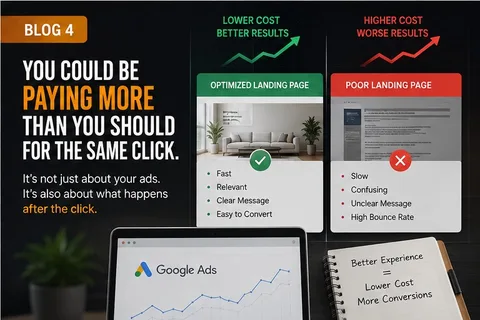
Google Ads can be one of the fastest ways to bring potential customers to your business.
You choose the keywords.
You create the ads.
You set a budget.
Someone searches for what you offer, sees your ad, clicks, and lands on your website.
Simple.
At least, that is how it looks from the outside.
The problem is that many businesses focus almost entirely on the ad and forget what happens after the click.
When a campaign becomes expensive, the first instinct is usually to blame the keywords, the bidding strategy, the agency or the ad copy.
Sometimes that is exactly where the problem is.
But not always.
Sometimes the problem begins the second a person arrives at your website.
Imagine two companies competing for a very similar customer.
Both are advertising on Google.
Both offer essentially the same service.
Both are bidding on similar keywords.
A potential customer clicks on the first ad.
The page takes too long to load.
The text is difficult to read on a phone.
The visitor has to scroll several times to understand what the company actually offers.
The button to contact the business is buried somewhere on the page.
The customer hesitates.
Then leaves.
A few minutes later, that same person clicks on another ad.
The second page loads almost immediately.
The message is clear.
The customer understands in a few seconds that they are in the right place.
The phone number is visible.
The next step is obvious.
Maybe they can schedule an appointment immediately.
Maybe someone answers their question.
Maybe the entire experience simply feels easier.
Both companies paid for a click.
But only one of them gave that click a real chance to become a customer.
That difference matters far more than many businesses realize.
Google does not look only at how much money you are willing to spend on advertising.
The platform also evaluates the relevance and quality of the experience connected to the ad.
In other words, the page you send people to matters.
A lot.
Google’s own Ads Help documentation is direct about this: higher ad quality generally leads to better performance, including better ad positions and lower cost.
If someone searches for a specific service and your advertisement promises exactly that service, but the landing page is slow, confusing or barely related to what the person expected to find, the entire experience becomes weaker.
And a weaker experience can hurt campaign performance.
This is one of the reasons two businesses can spend money on similar searches and end up with very different results.
It is also why simply increasing the advertising budget is not always the smartest answer.
If a campaign is sending people to a page that does not convert well, spending more money may simply mean paying to lose more visitors.
That sounds obvious when you say it that way.
Yet it happens every day.
Businesses spend thousands of dollars trying to generate more traffic while paying very little attention to the place where all of that traffic lands.
They measure clicks.
They measure impressions.
They measure how much they spend.
But sometimes the most important question is much simpler:
What happens when the person arrives?
Does the page immediately confirm that they found what they were searching for?
Does it load quickly on a mobile phone?
Can they understand the offer without thinking too hard?
Is there a clear next step?
Do they have a reason to trust the business?
Can they call, schedule, ask a question or move forward easily?
Or did you pay Google to send someone into a confusing room with no one there to help them?
That is why a landing page is not just a prettier version of your website.
It has a very specific job.
The person clicked for a reason.
The landing page needs to continue that same conversation.
If the ad says “Emergency Veterinarian Open Now,” the visitor should not land on a generic home page and start searching for emergency information.
If the ad says “Free Consultation,” the next step should not be hidden behind five menus.
If the ad promotes one particular service, the page should make that service immediately clear.
Every unnecessary step creates friction.
And every bit of friction creates another opportunity for the visitor to leave.
Now multiply that by every click you pay for during a month.
Suddenly, a small problem on a landing page can become a very expensive problem.
This is where technology, design and advertising stop being separate subjects.
They are all part of the same customer experience.
A fast page can help.
A clear message can help.
Better mobile design can help.
A stronger call to action can help.
A shorter form can help.
Automated follow-up can help.
Artificial Intelligence can even help answer questions or guide a visitor while their interest is still high.
None of those things guarantee that every click becomes a customer.
But together, they can make the money you are already spending work much harder.
And that is an important distinction.
Because sometimes the goal is not to buy more traffic.
Sometimes the goal is to waste less of the traffic you already bought.
This is especially important today because online advertising has become extremely competitive.
More businesses are bidding for attention.
Customers have more choices.
And patience is shorter than ever.
If a page takes too long, people leave.
If it is confusing, they leave.
If they cannot immediately see why your business is relevant, they leave.
And when they leave, Google does not refund the click.
You already paid for it.
That is what makes this one of the most overlooked expenses in digital advertising.
The business sees the charge from Google.
What it often does not see is the money lost between the click and the customer.
A campaign can look expensive because the cost per click is high.
But it can also feel expensive because too few of those clicks turn into opportunities.
Those are two very different problems.
And fixing the second one may sometimes be much more valuable than trying to negotiate a cheaper click.
So before asking:
“How can we spend more on Google Ads?”
It may be worth asking:
“Are we making the most of every person we already pay to bring to our website?”
That question can lead to some uncomfortable discoveries.
Maybe the page is too slow.
Maybe the message does not match the ad.
Maybe the form asks for too much information.
Maybe nobody responds quickly enough.
Maybe the site looks fine on a computer but becomes frustrating on a phone.
Maybe the customer simply does not know what to do next.
None of those problems are glamorous.
But solving them can have a direct impact on what your advertising actually produces.
Because a good Google Ads campaign does not end when someone clicks.
That is where the real work begins.
If you are investing in Google Ads and want to understand whether your website and landing pages are helping or hurting the return on that investment, talk to Sam Berner.
The conversation does not have to begin by spending more money on advertising.
It can begin by looking at what happens after the click.
Because sometimes the fastest way to improve your advertising is not to buy more traffic.
It is to stop wasting the traffic you already paid for.
Talk to Sarah