
For many years, growing a business almost always meant the same thing: more customers, more work and, sooner or later, more employees.
It was a perfectly logical equation. If more calls came in, someone had to answer them. If the number of customers increased, someone had to enter their information. If there were more appointments, documents, emails and follow-ups, that work had to be divided among more people.
That is how we learned to run businesses.
And for a long time, there was no reason to question it.
But something changed.
Artificial Intelligence entered the business conversation in a strange way. At first, most of us got to know it as a tool that could write text, answer questions or generate images. For many people, that is still what AI means: something interesting, useful for certain tasks, but still somewhat removed from the day-to-day operation of a business.
The reality is that we are already much further ahead.
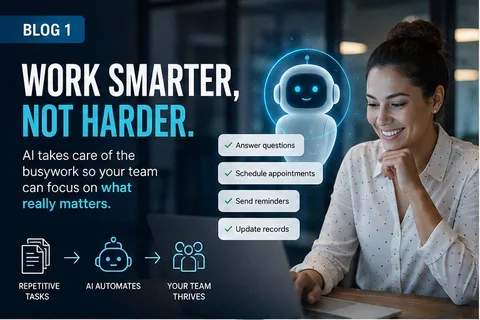
Today, Artificial Intelligence can answer a phone call, hold a conversation, ask questions, understand what a prospect needs, collect their information, check a calendar, schedule an appointment and send a confirmation. It can also read documents, extract information, update systems, follow up with customers and trigger complete workflows without someone manually moving information from one place to another.
And that begins to change one of the oldest rules in the workplace.
Because maybe the problem is not that your business needs more people.
Maybe part of the problem is that your people are still spending too much time doing tasks technology can already handle.
Think about it for a moment.
How much time is spent every day copying information from an email into a CRM? How much time goes into confirming appointments? Chasing missing documents? Answering the same questions? Reviewing forms, sending reminders, updating records or searching for information scattered across different systems?
Five minutes here does not seem important.
Ten minutes there does not seem important either.
But when those tasks are repeated every day, by several employees, throughout an entire year, they can add up to hundreds or even thousands of working hours.
And that is where the real cost begins to appear.
Not only in what you are paying for those hours, but in everything your people are not doing while they are busy with them.
A salesperson entering data is not selling. A manager searching for documents is not solving problems. A customer service employee spending half the morning updating systems is not talking to customers. And a business owner buried in administrative processes has less time to think about growth, strategy and new opportunities.
That lines up with what McKinsey’s own research on AI in business has found: most current applications of AI are tools that accelerate existing work, not full replacements for it.
That is why the conversation around Artificial Intelligence should not be reduced to whether it will replace jobs.
That is far too simple.
For many businesses, the most immediate opportunity is using technology to remove repetitive work and allow people to focus on the things where they truly create value.
Selling. Negotiating. Solving. Creating. Serving. Persuading. Making decisions. Building relationships.
Those things are still deeply human.
What is changing is everything around them.
And if you think about it, we have already lived through transformations like this before.
There was a time when sending a document meant using a fax machine. There was a time when making a bank transfer meant physically going to the bank. There was a time when getting lost while driving was completely normal because we depended on paper maps.
Today, those things feel distant, but they did not disappear overnight. At some point, a better way became available and, little by little, everyone adopted it.
Artificial Intelligence is creating a similar shift.
Only much faster.
Over the next few years, we will see companies that continue operating almost exactly the way they do today, while others begin automating many of the processes that do not require human intervention.
Two companies may sell exactly the same thing and still operate in completely different ways.
One may need to hire another person every time the workload increases. The other may be able to absorb part of that growth with systems that answer, organize, classify, record and follow up automatically.
One will respond when someone has time.
The other may respond in seconds.
One will depend on someone remembering to send a follow-up.
The other may do it automatically.
One will operate mainly during business hours.
The other may keep certain processes running 24 hours a day.
That does not turn the second company into a “technology company.”
It simply makes it a company that is using the technology available today more effectively.
And that may become one of the biggest competitive differences of the next few years.
So the real question is not whether you need to “bring AI into your business.”
It is not even whether you need to buy a new platform.
The first question should be much simpler:
What are we still doing today the same way we did five, ten or fifteen years ago simply because we have never stopped to question it?
It may be a phone call that went unanswered.
A prospect who received a response too late.
An employee spending hours entering data.
A document sitting somewhere waiting for someone to review it.
A customer who had to call twice.
Or dozens of small tasks that, when added together, are making your business slower and more expensive than it needs to be.
Artificial Intelligence will not transform every company in the same way.
And this is not about automating everything just because you can.
It is about understanding where automation actually makes sense.
Where it can improve the customer experience.
Where it can save time.
Where it can reduce errors.
Where it can allow your team to focus on more important work.
And where it can help you grow without making every new customer add another layer of complexity to your operation.
That is probably the best place to start.
Not by learning how Artificial Intelligence works.
But by understanding how your own business works.
If you want to explore which parts of your business could operate in a smarter way, talk to Sam Berner.
The conversation does not have to begin with technology. It can begin with something much simpler:
Tell me how your business works today.
From there, we can start discovering what no longer has to work the same way.
Talk to Sarah