
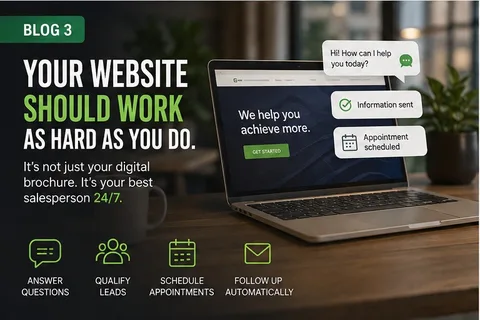
For years, having a website meant having a digital presence.
You put your logo at the top, added a few nice photographs, listed your services, included a phone number and maybe a contact form.
And that was enough.
If the site looked professional, even better.
That was the job of the website: to explain who you were and give people a way to contact you.
But the way people behave online has changed.
And many websites have not.
Today, when someone visits your site, they are usually not there just to admire the design.
They are looking for something.
An answer.
A price.
A solution.
An appointment.
A phone number.
A reason to trust you.
And most importantly, they want it quickly.
That is where a lot of businesses start losing opportunities without realizing it.
Researchers at the Nielsen Norman Group have found that a decision on aesthetics is made as early as 50 milliseconds into visiting a site, and rarely changes if you give people more time. That first impression is already forming before most of what your website says even has a chance to register.
Imagine someone finds your company at 9:30 at night.
Maybe they came from Google.
Maybe from an ad.
Maybe someone recommended you.
They land on your website and they are genuinely interested.
They read a little.
They like what they see.
Then they fill out a form.
And the website says:
“Thank you. Someone will contact you soon.”
That may have been acceptable ten years ago.
Today, it can be the exact moment when you lose the customer.
Because while your website is politely asking them to wait, they are still online.
They open another tab.
They visit a competitor.
That competitor answers the question immediately.
Maybe there is a chat assistant.
Maybe they receive a text.
Maybe they can book a call right there.
Maybe the process simply feels easier.
And just like that, the customer is gone.
The interesting part is that nothing technically failed.
Your website loaded.
The form worked.
The message was submitted.
Everything did what it was supposed to do.
And yet, the business still lost the opportunity.
That is one of the biggest changes in modern websites.
It is no longer enough for a website to simply exist.
It needs to participate.
A modern website should help move a person from interest to action.
It should make it easy to understand what you do.
It should guide the visitor to the right service.
It should answer common questions.
It should reduce hesitation.
It should make the next step obvious.
And increasingly, it can do much more than that.
A website can qualify a prospect before your team ever speaks to them.
It can collect the right information.
It can schedule an appointment.
It can send a confirmation.
It can trigger a follow-up.
It can connect with your CRM.
It can create a record.
It can route the customer to the right person.
It can even use Artificial Intelligence to interact with visitors in a much more natural way.
That changes the role of the website completely.
It stops being a brochure.
It starts becoming part of the operation.
And that matters because every visitor already represents effort and money.
Maybe you paid for Google Ads.
Maybe you invested in SEO.
Maybe you posted on social media.
Maybe someone referred the person to you.
Whatever the source, something brought that visitor to your site.
If they leave without taking action because the experience was slow, confusing or passive, all of that effort was wasted.
This is why a beautiful website is not necessarily a good website.
A beautiful website can still make people search too hard for information.
It can still load slowly.
It can still ask visitors to fill out a long form.
It can still give them no immediate response.
It can still look impressive while doing very little to help the business.
The question is no longer only:
“Does my website look good?”
A much better question is:
“What does my website actually do when a potential customer arrives?”
That answer can tell you a lot.
Does it simply show information?
Or does it help?
Does it wait for the visitor to figure everything out?
Or does it guide them?
Does it collect a name and email and leave the rest for tomorrow?
Or does it immediately move the person into the next step?
That difference may seem small.
But over hundreds or thousands of visitors, it can become a major business issue.
We have spent years thinking of websites as marketing tools.
Now they are becoming operational tools too.
And Artificial Intelligence is accelerating that shift.
A modern site can recognize what someone is looking for, respond to questions, collect context and help move the conversation forward before a human employee ever gets involved.
That does not mean removing people from the customer experience.
It means using technology to make sure people enter the conversation at the right moment.
Your team should not have to spend time answering the most basic question 40 times a week if the website can answer it immediately.
Your salesperson should not have to begin every conversation by asking for information the customer could have already provided.
Your office should not have to manually send every confirmation or reminder.
A good digital experience removes unnecessary friction before it ever reaches your team.
And that is what many businesses are missing.
They spend money trying to bring more people to a website that was never designed to convert those people efficiently.
It is a little like spending money to bring customers into a store and then leaving them alone at the entrance.
No greeting.
No direction.
No help.
Just a sign that says:
“Look around and let us know if you need anything.”
Some customers will stay.
Many will leave.
A modern website should behave differently.
It should make the customer feel that something is happening from the moment they arrive.
That does not require flashing animations or complicated technology.
Often, the best experience feels simple.
The visitor understands where they are.
They quickly see that you can help.
The next step is obvious.
And when they take it, the business responds.
That is what a website should be doing in 2026.
Not just displaying your business.
Helping operate it.
So if your website has not changed much in the last several years, the biggest issue may not be the colors, the photographs or even the design.
The bigger question may be whether it was built for the way customers behave today.
Because your next customer may visit your website tonight.
They may be ready to buy.
Ready to call.
Ready to schedule.
Ready to move forward.
And if your site simply asks them to wait until tomorrow, someone else's website may not.
If you want to understand whether your website is actually helping your business generate and convert opportunities, talk to Sam Berner.
The conversation does not have to begin with a redesign.
It can begin with one simple question:
What happens today when a potential customer arrives at your website?
The answer may reveal much more than how good your website looks.
Talk to Sarah